
Description
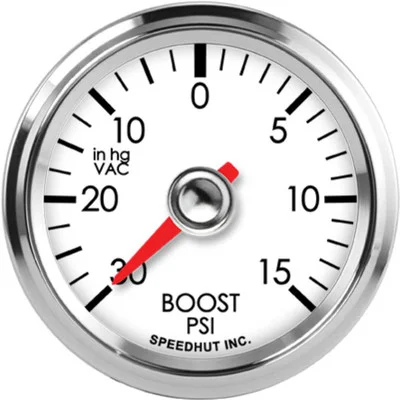
The Speedhut 2-1/16″ 30inhg-0-15 PSI Boost/Vac Gauge (L2-BV2-LEG) is a vital instrument for monitoring the performance of turbocharged or supercharged engines. This gauge accurately displays both intake manifold vacuum and turbocharger/supercharger boost pressure, allowing you to keep a close eye on your engine’s health and performance. Its classic design ensures it integrates seamlessly with a wide range of vehicle interiors.
KEY FEATURES AND BENEFITS:
- Dual Functionality: Measures both vacuum (30 inHg to 0) and boost (0 to 15 PSI), providing comprehensive engine pressure data.
- Accurate Readings: Utilizes a high-quality 3-Wire Military Grade Transducer (Performance) for precise and dependable measurements.
- Standard Size: The 2-1/16 inch (52mm) diameter ensures easy installation in most standard gauge pods.
- Complete Installation Kit: Ships with all necessary components, including the pressure sensor, wiring harnesses, and vacuum hose kit, for a straightforward setup.
- Reliable Performance: Built with quality components to withstand the demands of automotive environments.
- Clear Visibility: Features LED backlighting (though the specific color isn’t specified) for easy reading in all lighting conditions.
SPECIFICATIONS:
- Gauge Type: Boost/Vacuum Gauge
- Pressure Sender Type: 3-Wire Military Grade Transducer (Performance)
- Range: 30 inHg – 0 PSI (Vacuum) / 0 – 15 PSI (Boost)
- Size: 2 1/16 inch (52mm)
- Mounting Hole Size: 2.062 inches (52mm)
- Units: Standard (inHg, PSI)
- Warning Light: No
- Included:
- Pressure Sensor – 30 PSI
- 3 ft Power & Lighting Harness – for LED Lit Gauges and Clocks
- Boost/Vac Hose Kit
- Pressure Gauge Wiring Harness (3-Wire Cable)
HOW TO USE:
- Mount the Gauge: Choose a suitable location in your vehicle and drill a 2.062-inch (52mm) hole. Secure the gauge in place.
- Install the Pressure Sensor: Locate a suitable vacuum/boost source on your engine’s intake manifold. Install the provided pressure sensor at this location.
- Connect the Vacuum/Boost Hose: Attach one end of the included boost/vac hose to the pressure sensor and the other end to the back of the gauge.
- Connect the Wiring Harnesses:
- Connect the 3-wire cable from the pressure sensor to the corresponding terminals on the back of the gauge.
- Connect the 3 ft power and lighting harness to a suitable 12V power source in your vehicle (following the harness instructions for power and ground).
- Test the Gauge: Start your vehicle and observe the gauge readings to ensure proper installation and function. The gauge should show a vacuum reading at idle and a boost reading when the engine is under load (if applicable).
BENEFITS OF USING THE SPEEDHUT 2-1/16″ 30INHG-0-15 PSI BOOST/VAC GAUGE (L2-BV2-LEG):
- Engine Health Monitoring: Allows you to track critical engine pressures, helping to identify potential issues before they become serious problems.
- Performance Awareness: Provides real-time feedback on your engine’s boost levels, crucial for understanding and optimizing performance.
- Prevent Over-Boosting: Helps prevent potentially damaging over-boost conditions in turbocharged or supercharged vehicles.
- Easy Installation: Comes with all necessary hardware, making the installation process relatively straightforward for automotive enthusiasts.
- Classic Aesthetics: The traditional design integrates well with a variety of dashboard styles.
- Accurate Data: The military-grade transducer ensures reliable and precise readings.
FEATURES:
- Displays Intake Manifold Vacuum: Provides readings from 30 inches of mercury down to 0.
- Shows Turbo/Supercharger Pressure: Indicates boost levels from 0 up to 15 PSI.
- Employs a Robust Transducer: Utilizes a 3-wire military-specification sensor for enhanced accuracy.
- Fits Standard Gauge Pods: The 2 1/16″ size is compatible with common aftermarket mounting solutions.
- Includes Necessary Hoses: Comes with the required vacuum and boost lines for connection.
- Supplied with Wiring: Includes both power/lighting and sensor wiring harnesses.
- Designed for Automotive Use: Built to withstand typical vehicle operating conditions.
Reviews
There are no reviews yet.